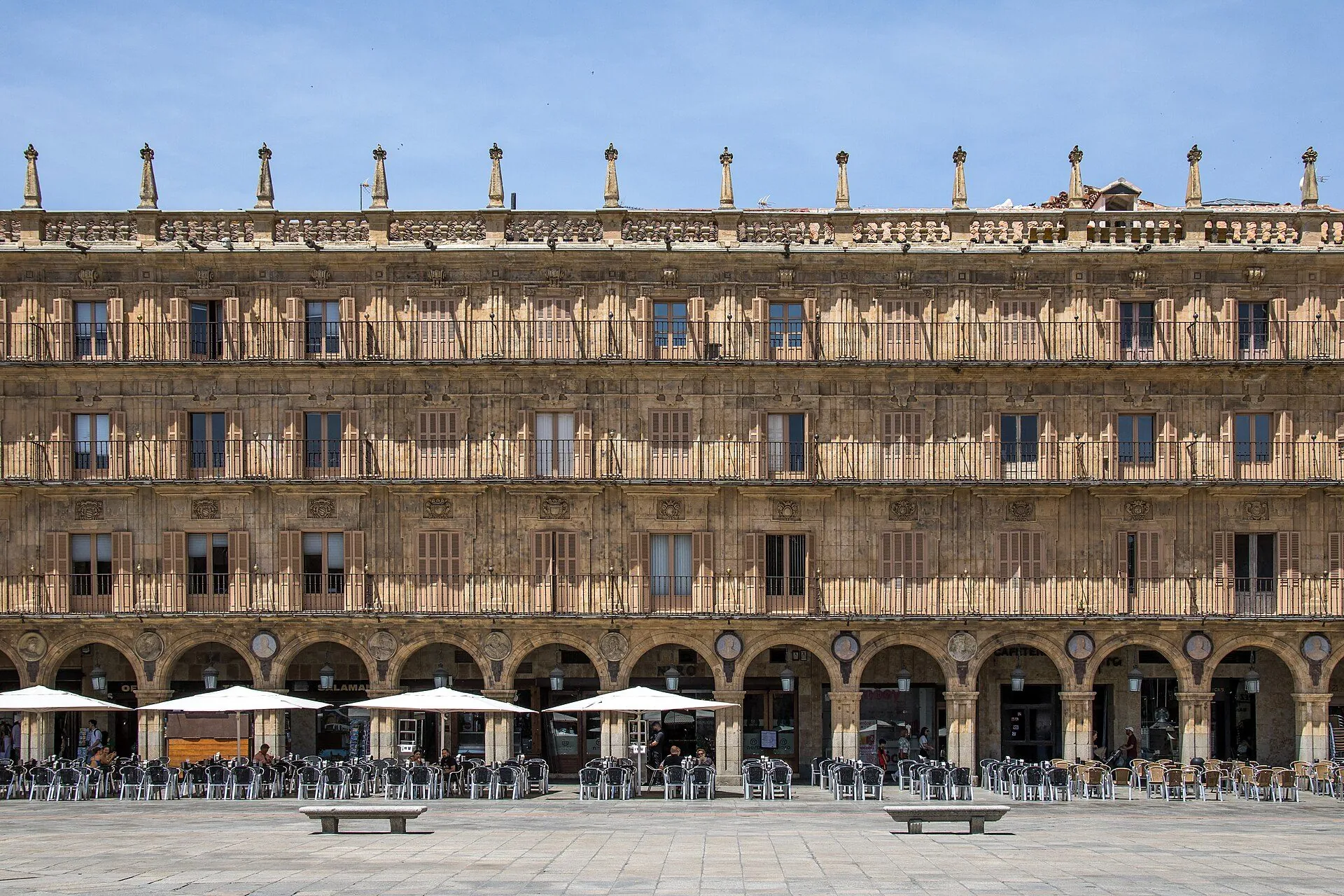
“Shalamanqa”, on the Tormes river: a frontier land in the Andalusi period, then a university city since its university was founded in 1218 CE, one of Europe's oldest. Its old town is listed as a World Heritage site.
Figures of Salamanca
1444–1522
Antonio de Nebrija
He studied and taught at the Universidad de Salamanca. In 1492 he published the first grammar of the Castilian language, and a statue of him stands in front of the university.
1452–around 1515
Abraham Zacut
A Jewish astronomer born in Salamanca; Portuguese navigators used his astronomical tables.
around 1483–1546
Francisco de Vitoria
A professor at the Universidad de Salamanca, considered one of the founders of international law; his statue stands in front of the Convento de San Esteban.
1527–1591
Fray Luis de León
A poet and professor at the Universidad de Salamanca; his statue stands in the Patio de Escuelas, and his lecture room is preserved.
Chapter Two
Ready-made trips
1 hour-by-hour day plan and 2 walking routes I drew myself in Salamanca, with the places to pray and eat where I marked them.
One of Europe's oldest universities (1218). Its Plateresque facade, carved like embroidery, hides a frog on a skull that visitors compete to find, and its historic library is among the most precious.
My tip
Closed on Sunday afternoons; look for the frog on the right side of the facade.
A Roman bridge over the Tormes river, from the 1st century CE; 15 of its original arches still stand, and at its entrance is the stone bull “Verraco”, the city's symbol. From the opposite bank comes the most famous view of Salamanca's two cathedrals.
My tip
30 minutes; cross it fully to take a picture of the city from the south bank. Level and suitable for strollers. Wonderful at night with the lights.
A modernist mansion with a stained-glass facade above the old wall, housing luxurious collections of glass, bronze, antique dolls and perfume bottles. One of Spain's most beautiful small museums.
My tip
One to one and a half hours; about €5. Photography is not allowed except in the café. A lift is available.
A Gothic palace from the late 15th century, its facade decorated with more than 300 stone shells; in its courtyard are windows with Mudéjar arches, and today it is a public library.
My tip
Entry to the courtyard is free; from the upper floor you can see the tower of the Pontifical University opposite.
Walls run along the facade of the mountain town of Béjar, with a lovely walkway and views over the valley of the Cuerpo de Hombre.
Easy to reach
Buses from Salamanca and Madrid; the walkway on the walls is almost level and free, and the town sits on the edge of a mountain with sloping streets. Full facilities.
My tip
The walkway is free and open; in the town there is the ducal palace and the nearby gardens, the Orchard (El Bosque).
Refined Castilian and Mediterranean cuisine in an elegant classic dining room.
A favourite of mine
The best restaurant in Salamanca and the author's only recommendation there: refined service, skilful dishes and a quiet atmosphere suited to families and special occasions, on the other bank of the river near the Parador.
TryPrawn rice, the daily fish, braised oxtail (ask whether it is free of wine)
“The only recommendation in Salamanca: the best restaurant in the city.”
Booking essential · Smart casual · Suits families and children, business meetings and couples
The restaurant of chef Alberto Rodríguez, who holds a Michelin star, near the Convento de San Esteban, re-presents Castilian cuisine with a contemporary touch.
The finest table in Salamanca and the most highly rated by the guides; suitable for occasions and business hospitality.
TryTasting menu, with requested alternatives to the pork dishes, Morucha beef, seasonal vegetables, desserts
Booking essential · Suits couples and business meetings
A classic restaurant on the Plaza del Poeta Iglesias, a few steps from the Plaza Mayor, with warm wooden dining rooms and charcoal grills.
A perfect location among the sights and a skilfully prepared Castilian cuisine with local meats, open daily; it combines elegance with a family atmosphere.
A refurbished restaurant with a quirky, distinctive décor near Salamanca's central market, serving traditional cuisine with dazzling presentation and showy desserts.
One of the most popular and highly rated restaurants in the city; a fun experience for families and small celebrations.
TryCooked artichoke, lamb, lemon tart, cheesecake
Booking advised · Suits families and children, couples and friends and groups
A campsite with wooden cabins and a pool in the Arribes del Duero nature reserve, where the river cuts deep gorges on the Portuguese border.
Easy to reach · needs a car
On the edge of Lumbrales, on a paved road with parking inside the campsite. The town (shops, pharmacy) is nearby. The viewpoints over the Duero gorges (such as Pozo de los Padres) are 15–30 min by car, then a short walk. A remote area; a car is essential.
My tip
A boat trip into the Duero gorge from a mirador or from Vilvestre is a wonderful experience for families.
A small romantic garden on the old wall, inspired by the novel “La Celestina”, overlooking the Roman Bridge and the Tormes river. A quiet refuge between the cathedral and the river.
My tip
20–30 minutes; free. Most beautiful in spring and at sunset. Combine it with the nearby Casa Lis museum and a walk down to the Roman Bridge.
A town enclosed by a rare circular wall of brick and rammed earth, with tall towers; Queen Isabella the Catholic was born here in 1451 CE, in the palace of King Juan II, which became a convent of nuns.
What to see
The circular wall, its towers and its four gates · Palace of Juan II (Augustinian convent), where Isabella was born · Church of San Nicolás with its Mudéjar ceiling · The old Royal Hospital
Easy to reach · needs a car
Two hours from Madrid or an hour from Salamanca by car. The town is flat and quiet; an hour and a half.
My tip
The birthplace palace is visited on short tours run by the convent; check the times. Combine it with Arévalo (25 km) in one day.
A walled town on a rock above the Tormes river, linked to the far bank by a medieval bridge rebuilt in the 15th century on Roman foundations. It was the Roman city of “Bletisa”, and it still keeps its walls, its church and its square.
What to see
The old bridge with its five different arches · The walls and the San Nicolás gate · The church of Santa María la Mayor and the main square · The fort of the Dukes · The Ledesma thermal baths (10 km)
Easy to reach · needs a car
35 minutes from Salamanca by car, with few buses. The town is small with gentle slopes; an hour and a half.
My tip
Guided tours are booked at the town hall opposite the church, and they are excellent. Combine it with Salamanca in half a day.
A 15th-century castle converted into a hotel in the middle of a large estate, about 20 minutes north of Salamanca. A stay in a real castle, with an excellent restaurant.
My tip
Children love it, but most of it has no lifts; ask for ground-floor rooms if you are travelling with older people.
The first Spanish town declared a “Historic-Artistic Ensemble” (1940): stone houses with timber frames, flowering balconies and a main square with arcades, in the green mountains of the Sierra de Francia. An hour and a half south of Salamanca.
My tip
Half a day; cobbled lanes that are not level. Honey and chestnut shops are plentiful (be aware that many of the products are pork products). Afterwards, go up to the summit of Peña de Francia (1723 m) for the view.
A viewpoint on a sheer edge over the deepest gorges of the Duero river, which divides Spain and Portugal, in the Arribes natural park, where griffon and black vultures and black storks soar.
My tip
A short, very steep walk from the road; not suitable for anyone who is afraid of heights. Combine it with the environmental boat trip on the river.
A large resort with villas, pools and a thermal spa at the entrance to the historic village of La Alberca in the Sierra de Francia. The grounds are green and suitable for children to run around, and it has independent family villas.
My tip
Choose the family villa; visit the village of La Alberca and Mogarraz on foot.
Friday prayer is usually at around 13:30–14:30 (it may be later, at 15:00, in summer); check with the mosque before then. Its information online is scarce; confirm the Friday times in advance.
The 15th-century palace of the Counts of Alba y Aliste in the heart of old Zamora, with a Renaissance courtyard, coats of arms, historic furniture and a pool. Zamora is a city of Romanesque churches and very quiet.
My tip
The pool is not heated; the street parking next door is cheaper than the hotel's car park, and the restaurant works to set times, so book in advance.
The 14th-century castle of Enrique II on the walls of Ciudad Rodrigo, overlooking the Águeda river near the Portuguese border, recently restored. Guests rate the restaurant excellent.
My tip
The whole walled old town can be seen on foot; map apps may take you down narrow lanes, so follow the castle signs.
A small boutique hotel (14 rooms) in an elegant palace near the river and the cathedrals, one of the highest-rated hotels in Spain. Personal service with careful details.
My tip
It has a family room made of two connected rooms in a private corridor, ideal for families; parking with a valet service.
A luxury design hotel in part of the Convento de San Esteban, with a garden, a pool and a view of the towers and the cathedral. A few minutes' walk from the Plaza Mayor.
My tip
The pool is seasonal; the Marriott loyalty programme is not fully applied here.
An iron market with coloured glass windows right behind the Plaza Mayor: fruit, vegetables, cheeses, local eggs and the famous La Armuña chickpeas. Be aware: many of the stalls sell pork products.
My tip
30 minutes in the morning; closed on Sundays. Buy La Armuña chickpeas and local sheep's cheese as a gift.
Two pedestrian streets: “Rúa Mayor”, which links the Plaza Mayor with the Casa de las Conchas and the university, lined with cafés and bookshops, and “Calle Toro”, the main shopping street with Spanish brands.
My tip
One to two hours; both are level and suitable for strollers. Shops usually close 14:00–17:00 and are closed on Sundays.
A route climbing the towers of the old cathedral and its upper walkways to the roof, with panoramic views over the golden city and its domes. An architectural experience more than a religious one.
My tip
One hour; about €4–6. A narrow stone staircase with many steps, not suitable for those who suffer from dizziness or for strollers. A guided night visit is available.
A climb to the two towers of the Jesuit Baroque building “La Clerecía” (17th–18th century), opposite the Casa de las Conchas; from the top are the best views of the two cathedrals, the university and the square.
My tip
45 minutes; about €6. Many steps. On Wednesday mornings it is sometimes free — check.
The oldest café in Salamanca, opened in 1905 on the Plaza Mayor. It was the gathering place of the university's professors and writers: Miguel de Unamuno, and Gonzalo Torrente Ballester, whose bronze statue now sits at his usual table.
My tip
Order chocolate with churros in the morning or coffee with the house dessert in the afternoon, and sit on the terrace on the square. The best time is sunset, when the square's golden stones glow.
The oldest university in Spain still operating, founded in 1218 and a world reference for teaching the Spanish language and for law and literature. A safe, quiet university city where costs are lower and Spanish is widely spoken.
My tip
Look for the “frog” on the facade of the historic building, as visitors do; and for anyone who wants to learn Spanish, the university's “International Courses” are among the most established options.
One of Spain's longest-established Spanish-language programmes for foreigners, run by the oldest Spanish university; the Universidad de Salamanca is a partner of the Instituto Cervantes in setting the DELE. Intensive courses throughout the year, summer courses and courses to prepare for the DELE.
My tip
Salamanca is a small city where English is rarely spoken, so fluency comes faster; choose a homestay with a Spanish family to immerse yourself in the language.
A school accredited by the Instituto Cervantes in the historic heart of Salamanca (the shared headquarters of the Enforex and don Quijote brands), suitable for school groups and students.
My tip
It organises trips to Segovia and tapas dinners; Salamanca's summer is very hot, so choose spring or autumn.
Among my best months An event or holidayBars: lowest and highest temperature
May8° to 21°
Pleasant (8–21°C). We recommend the Huerto de Calixto y Melibea, overlooking the river.
No events listed in May. A quiet month, and prices are often lower.
Chapter Five
Where to stay in Salamanca
1
The historic city near the Plaza Mayor
Casco histórico (Plaza Mayor)
Salamanca is a small, safe city that can be visited entirely on foot: the Plaza Mayor, the university and the two cathedrals.
You'll find here
Boutique hotels in historic stone buildings, and 4-star hotels.
2
Around Gran Vía / Paseo de Canalejas
Gran Vía / Canalejas
On the edge of the centre; easier to reach by car and with better-value prices, and the sights are 10 minutes' walk away.
You'll find here
Modern mid-range hotels with parking.
Where I wouldn't stay
The area around the Plaza Mayor on Thursday–Saturday nightsPlaza Mayor (fines de semana de noche)
A student city; some streets around it are noisy at night at weekends, so ask for an inside room.
Hotels I recommend in Salamanca
Grand Hotel Don Gregorio ★★★★★
Parador de Salamanca ★★★★
Chapter Six
What to bring home
What deserves to come home with you from Salamanca: the genuine article, and what carries a protected origin.
IGP
La Armuña lentils
Lenteja de La Armuña IGP
Large pale-green lentils “Rubia de La Armuña”, thin-skinned and not breaking up when cooked, among the finest lentils in Spain.
Pedrosillo chickpeas
Garbanzo de Pedrosillo
A small, creamy chickpea from the village of Pedrosillo el Ralo, popular with chefs.
Caramelised almonds of Alba de Tormes
Almendras garrapiñadas de Alba de Tormes
Almonds coated in caramelised sugar, an old tradition of the convents of Alba de Tormes.
IGP
Morucha beef
Carne de Morucha de Salamanca IGP
Beef from the local “Morucha” breed; halal slaughter is required. Warning: “hornazo” and “farinato” contain pork, and “perrunillas” are made with lard, so exclude them.
Chapter Seven
Getting around Salamanca
Salamanca is a small city that can be visited entirely on foot; the station is 20 minutes' walk or 5 minutes by taxi from the Plaza Mayor. Urban buses cover the longer distances. There is no major commercial airport; the journey from Madrid is by Alvia train (around an hour and 40 minutes) or direct Avanza buses (around 2.5 hours). Taxis are available. Tips: the centre is a pedestrian area, so park in the public car parks on its edges.